For centuries, the Holy Grail of the investing world has been an elusive, highly toxic psychological pursuit: timing the market. Novice investors and speculative traders spend countless hours staring at macroeconomic indicators, corporate earnings reports, and technical charts, attempting to predict the exact cyclical bottom to deploy their capital and the exact peak to liquidate their positions.
In the real world of wealth management, this approach is a statistical disaster. Academic research and market data consistently demonstrate that even professional fund managers fail to accurately time market swings over a multi-year horizon. For the individual retail investor, attempting to time the market typically results in the worst possible behavioral outcome: buying at the peak driven by FOMO (Fear of Missing Out) and selling at the absolute bottom out of sheer panic.
To achieve sustainable compounding returns in the modern equity landscape, investors must abandon the myth of perfect timing. They need a system that strips away human emotion, automates execution, and exploits market volatility to their advantage. The most mathematically sound and behaviorally resilient weapon for long-term equity accumulation is Dollar-Cost Averaging (DCA).
The Mathematical Mechanics of Dollar-Cost Averaging
At its core, Dollar-Cost Averaging is a structural investment strategy where an individual invests a fixed dollar amount into a specific asset (such as an index fund, an exchange-traded fund, or a blue-chip stock) on a strict, unyielding chronological schedule—regardless of the asset’s current price. Whether the market is surging to all-time highs or crashing into a deep bear territory, the allocation remains completely static.
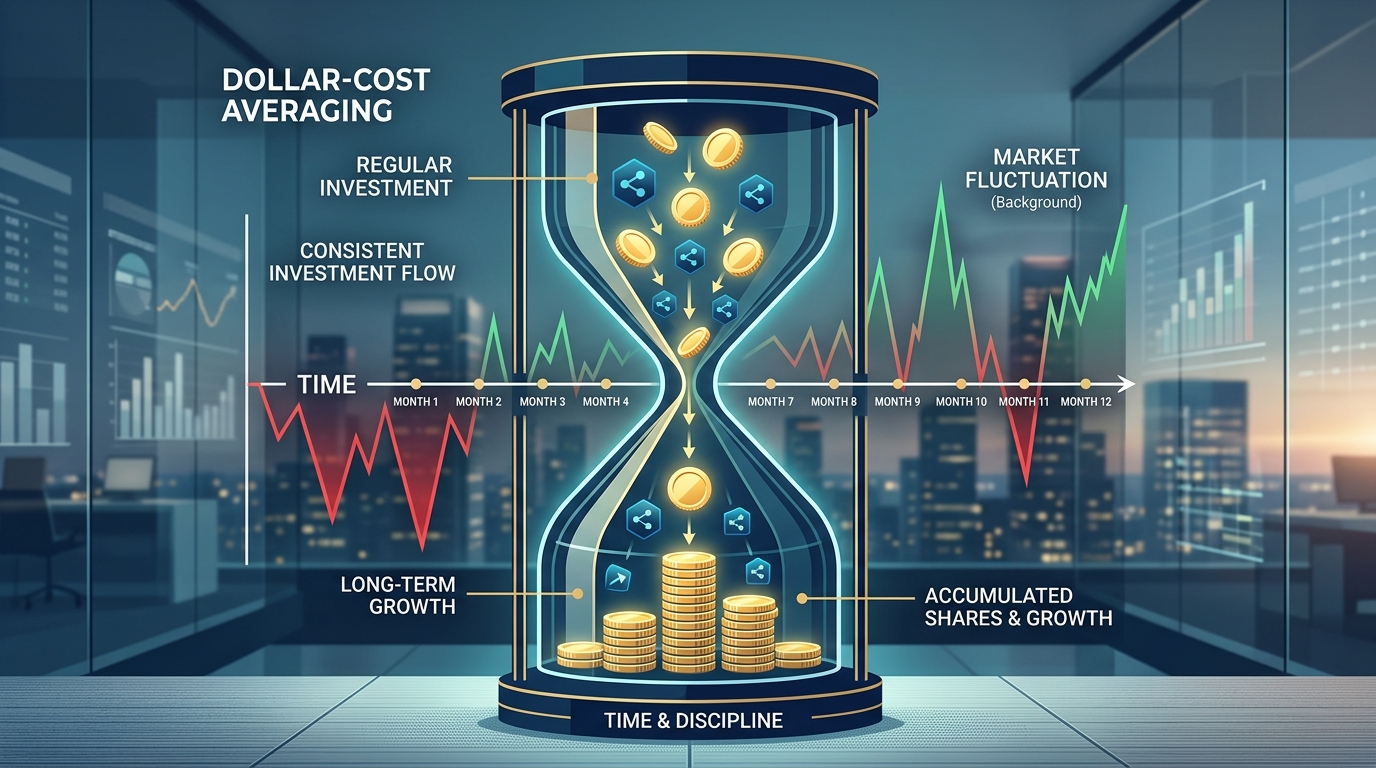
The mathematical brilliance of DCA lies in the inverse relationship between asset price and volume acquisition. Because you are investing a fixed amount of currency every single month, the system automatically forces you to alter the number of shares you purchase based on market conditions:

When the stock market enters a correction phase and prices plummet, your fixed dollar allocation naturally buys more shares. Conversely, when the market climbs and prices become expensive, your fixed allocation naturally buys fewer shares. Over a prolonged operational horizon, this mechanical asymmetry produces a highly desirable mathematical phenomenon: it structurally lowers your average cost per share compared to the average market price over that same duration.
DCA vs. Lump-Sum Investing: The Systematic Trade-Off
To truly appreciate the strategic positioning of DCA, one must evaluate it against its primary structural alternative: Lump-Sum Investing (LSI)—the practice of deploying all your available investment capital into the market in a single transaction.
On a pure mathematical basis, historical backtests show that Lump-Sum investing outperforms DCA roughly 66% of the time over a long-term horizon. The reason is simple: equity markets spend significantly more time rising than they do falling. Therefore, getting your money into the market as early as possible allows the maximum volume of capital to compound for the maximum amount of time.
However, looking strictly at the math ignores the defining variable of personal finance: human psychology.
Imagine a professional who inherits or saves $100,000. If they deploy that entire sum on a Monday via a Lump-Sum transaction, and a major geopolitical shock causes the stock market to crash by 20% over the next two weeks, the immediate psychological trauma is devastating. They see a visual loss of $20,000 on their balance sheet. History shows that a massive percentage of retail investors will panic under this level of stress, liquidate their remaining assets to “prevent further loss,” and permanently exit the wealth-building ecosystem.
DCA acts as an elite psychological insurance policy. By spreading that $100,000 across 12 or 24 monthly installments, the investor reframes their relationship with market volatility. If the market crashes next week, they do not panic; instead, they celebrate, knowing that their next monthly installment will acquire shares at a massive 20% discount.
Designing a High-Resilience DCA Portfolio
Implementing an effective DCA strategy requires moving past individual speculative assets. Applying DCA to a single volatile growth stock or an unproven cryptocurrency is highly dangerous; if the underlying asset permanently collapses to zero, averaging down simply accelerates your capital destruction.
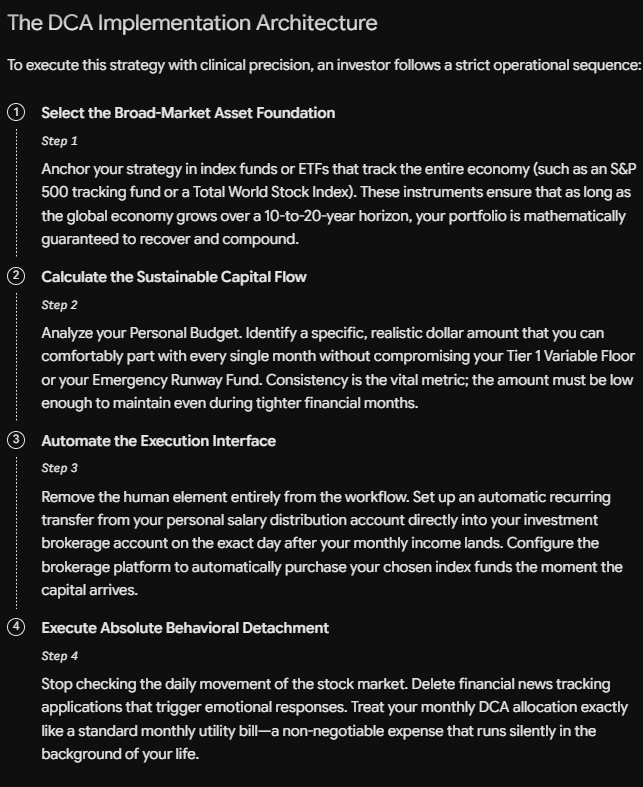
Therefore, professional DCA strategies should be anchored in broad-market, highly diversified, low-cost index assets.
The Dynamic Rebalancing Variant: Advanced DCA
While classic DCA demands complete automation, sophisticated wealth managers often utilize a hybrid model known as Value Averaging or Dynamic DCA. Under this advanced framework, you adjust your monthly contribution slightly based on extreme valuation metrics.
For example, you establish a baseline monthly contribution of $1,000. However, you couple this with a simple market health metric, such as the Relative Strength Index (RSI) or the deviation from the 200-day moving average.
If the market enters an extreme, euphoric bubble and reaches overbought territory, your Dynamic DCA system automatically scales your monthly contribution down to $750, accumulating cash reserves in a high-yield bucket. Conversely, when the market experiences an aggressive panic crash and plunges into deep oversold territory, the system draws from the cash reserves and automatically scales your monthly deployment up to $1,500. This hybrid approach amplifies the cost-averaging effect, maximizing share accumulation precisely when historical risk is lowest.
Conclusion: The Ultimate Victory of Discipline Over Hype
The global financial markets are inherently chaotic, driven in the short term by the erratic shifts of human psychology, geopolitical shifts, and institutional high-frequency trading algorithms. Attempting to compete in that arena by trying to guess the next market bottom is a fool’s errand.
Dollar-Cost Averaging is the ultimate equalizer for the professional investor. It transforms market volatility from a terrifying threat into a valuable wealth-accumulation tool. By embracing structural automation, maintaining absolute behavioral discipline, and systematically treating every market dip as a massive buying opportunity, you remove the anxiety of investing and ensure that the long-term growth of the global economy is permanently working to build your net worth.