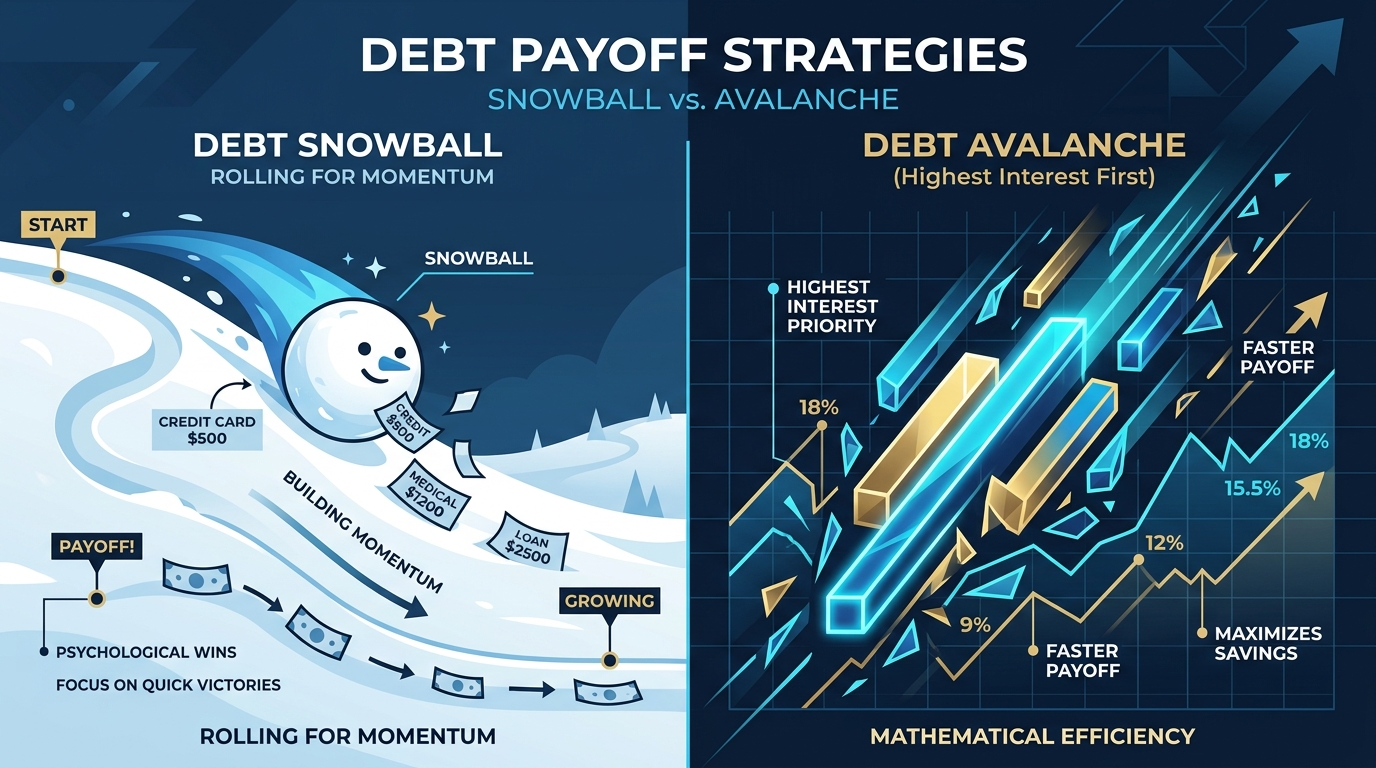
Living under the weight of compounding debt is one of the most pervasive systemic stressors affecting modern professionals. Whether it stems from student loans, high-interest credit card balances, or unexpected medical expenses, debt acts as a severe drag on net worth and long-term financial freedom. In the field of personal finance, the debate is rarely about whether to pay off debt, but rather how to structurally approach the liquidation process.
When consumers decide to aggressively tackle their liabilities, they inevitably find themselves at a crossroads between two foundational methodologies: The Debt Snowball and The Debt Avalanche.
While both systems share the exact same ultimate objective—achieving a zero-balance sheet—they operate on completely opposing behavioral and mathematical philosophies. One prioritizes human psychology and immediate emotional wins, while the other prioritizes pure mathematical efficiency and interest minimization. To choose the right weapon for your financial recovery, you must deeply understand the mechanical inner workings, structural pros, and psychological trade-offs of both strategies.
The Mechanics of the Debt Snowball: Engineering Emotional Momentum
Popularized by financial author Dave Ramsey, the Debt Snowball method is an explicitly psychology-first framework. It operates on a fundamental premise: personal finance is 80% behavior and only 20% head knowledge. Proponents of this method argue that if math were the only thing that mattered, most people wouldn’t have accumulated consumer debt in the first place. Therefore, to cure debt, you must first fix behavioral momentum.
The execution of the Debt Snowball is mechanically straightforward. You list all your debts in order of balance size, from smallest to largest, completely ignoring the interest rates associated with them.
You allocate all your surplus investment capital toward completely eradicating the smallest debt on the list while paying only the bare minimum required balances on all the larger debts. Once the smallest debt is wiped out, the entire monthly amount you were previously paying toward it is redirected—or “snowballed”—into the next smallest debt.
The primary benefit of this system is the rapid generation of dopamine loops. By targeting the smallest balance first, a consumer might completely eliminate a minor $500 credit card debt within the first 30 days. Visually crossing a debt off the list creates an immediate sense of accomplishment and self-efficacy. It proves to the debtor that the system works, providing the psychological stamina required to face larger, more daunting balances down the road.
The Mechanics of the Debt Avalanche: Optimizing for Pure Mathematical Efficiency
In stark contrast to the Snowball framework, the Debt Avalanche method is a clinical, cold, and mathematically optimized strategy. It completely discards emotional factors and treats your financial situation purely as an algorithmic problem to be solved with the lowest possible capital loss.
Under the Debt Avalanche protocol, you list all your liabilities in order of interest rate, from the highest annual percentage rate (APR) to the lowest, completely ignoring the total balance size.
You focus every single spare dollar on the debt with the highest interest rate—typically a high-interest store card or a predatory personal loan—while maintaining minimum payments on everything else. Once that peak interest rate is leveled, you cascade the payment power down to the card or loan with the next highest interest rate.
The structural advantage of the Avalanche method is irrefutable: it saves the maximum amount of money and minimizes the total duration of your debt journey. By attacking the highest interest rates first, you actively slow down the rate at which your total debt compound-grows against you. Every dollar wiped out at a 28% APR saves you far more money over time than a dollar wiped out at a 6% APR.
Side-by-Side Operational Execution
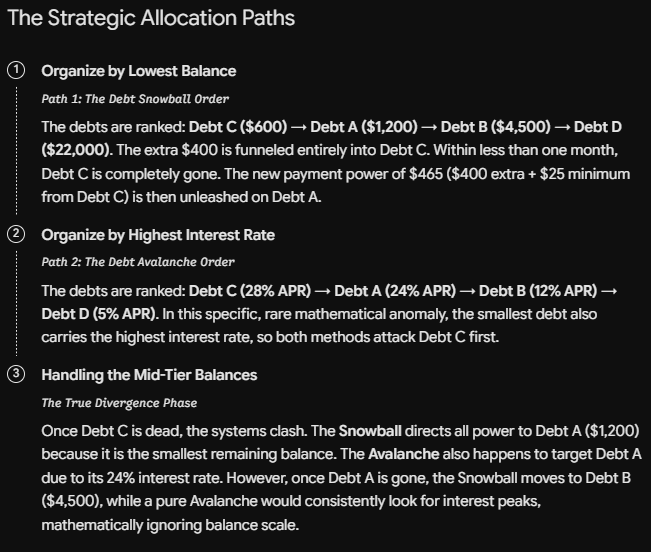
To see how these two systems diverge under pressure, let us evaluate a hypothetical scenario involving an urban professional carrying four distinct debts:
- Debt A: $1,200 Credit Card Balance at 24% APR (Minimum Payment: $40)
- Debt B: $4,500 Personal Loan at 12% APR (Minimum Payment: $110)
- Debt C: $600 Store Reward Card at 28% APR (Minimum Payment: $25)
- Debt D: $22,000 Student Loan at 5% APR (Minimum Payment: $250)
- Total Available Capital: The consumer has a baseline minimum payment requirement of $425, but can organically scrape together an extra $400 of surplus cash flow, bringing their total monthly debt payoff budget to $825.
The Behavioral Economics Break: Why Math Fails in the Real World
On paper, the Debt Avalanche is the superior strategy 100% of the time. It is mathematically impossible for the Snowball method to outpace the Avalanche in terms of total interest saved. Yet, empirical studies in behavioral economics frequently reveal a fascinating anomaly: consumers who use the Debt Snowball are statistically more likely to completely eliminate their debt.
A landmark study published in the Journal of Marketing Research analyzed thousands of real-world consumers fighting debt over several years. The researchers discovered that the sheer number of remaining accounts, rather than the dollar amount of the interest rate, had the most powerful impact on consumer persistence.
Human beings are highly sensitive to perceived progress. When a consumer uses the Debt Avalanche, they might spend 18 months chipping away at a massive $15,000 credit card balance because it carries a 29% interest rate, while leaving three smaller $1,000 accounts completely untouched.
Even though they are saving money mathematically, the visual reality looks stagnant. Monthly bills continue to arrive from four different institutions. The lack of an immediate “win” creates a sense of financial fatigue, leading many to abandon their budgets entirely and slide back into toxic spending habits. The Snowball cures this by shrinking the battlefield quickly, eliminating monthly billing statements one by one until the psychological horizon becomes manageable.
Framework Selection: How to Choose Your System
Choosing between these two systems requires rigorous self-awareness. There is no universally correct answer; there is only the correct system for your specific psychological profile and liability architecture.
You should choose the Debt Avalanche if:
- You are deeply analytical, disciplined, and motivated purely by numbers.
- Your highest-interest debts carry extreme, predatory rates (25% to 35% APR) and represent a massive portion of your total debt load.
- You possess high emotional stamina and do not need external validation or quick visual wins to stay committed to a long-term goal.
You should choose the Debt Snowball if:
- You feel completely overwhelmed by the sheer volume of separate bills arriving every month.
- You need immediate positive reinforcement to maintain lifestyle adjustments and strict budgets.
- Your smaller debts can be wiped out rapidly (within 60 to 90 days), giving you an instant structural cash-flow boost by eliminating their individual minimum payment requirements.
Conclusion: Execution Trumps Optimization
Ultimately, the optimal debt management strategy is not the one that looks prettiest on a spreadsheet; it is the one you will actually stick to until your balances reach zero. A mathematically sub-optimal plan executed with absolute consistency will always defeat a perfectly optimized plan that you abandon after three months.
Assess your debt portfolio, analyze your personal psychology, choose your framework with intent, and execute it without deviation. True financial freedom lies just on the other side of the zero baseline.