

The rise of the global gig economy has fundamentally transformed the traditional structure of work. Millions of professionals have traded the predictability of a bi-weekly corporate paycheck for the autonomy, flexibility, and creative freedom of freelancing. However, this liberation comes with a significant systemic trade-off: extreme income volatility.
For a freelancer, a single month can bring a massive windfall from a corporate retainer, followed immediately by a two-month dry spell where clients delay invoices or projects stall. In this financial environment, standard budgeting advice completely falls apart. Traditional models assume a baseline of predictable, static inflows. When your income looks like a rollercoaster rather than a straight line, trying to fit your life into rigid structures creates immediate anxiety.
To survive and thrive under these conditions, freelancers need a financial system that is mathematically precise yet structurally adaptable. The most effective weapon against the chaos of irregular income is Zero-Based Budgeting (ZBB). Originally designed for corporate cost management, ZBB requires you to justify every single dollar of your income every single month, effectively giving “every dollar a job” until your budget equals exactly zero.
Here is a comprehensive, journalist-grade operational blueprint on how to adapt Zero-Based Budgeting to conquer a volatile freelance income.
The Anatomy of Zero-Based Budgeting for Freelancers
At its core, the philosophy of Zero-Based Budgeting is simple: Income minus Expenses equals Zero. This does not mean your bank account reaches zero at the end of the month. Rather, it means that every single dollar that flows into your possession is intentionally directed toward a specific destination—whether that is rent, groceries, tax allocations, or long-term investments. You leave no money “floating” aimlessly, as unallocated cash is the primary catalyst for impulsive spending.
For a salaried worker, ZBB is done at the beginning of the month because they know exactly what they will earn. For a freelancer, the process must be inverted. You cannot allocate money you haven’t received yet. Therefore, the golden rule of freelance ZBB is: You only budget the money you already have in your account today, never the money you expect to receive tomorrow.
To implement this without causing immediate cash-flow friction, freelancers must abandon the habit of mixing personal and business funds. You must establish a structural buffer system that decouples your client payments from your personal life expenses.
Phase 1: Building the Infrastructure (The Two-Tier System)
Before allocating a single dollar, you must build the structural pipelines to manage the money. Freelancers who operate out of a single bank account are constantly flying blind, unable to distinguish between business revenue, tax liabilities, and personal spending money.
You need to establish a Two-Tier Banking System:
- The Business Capital Holding Account: This is the universal collection bucket. All client payments, invoice completions, and project fees land here. You never spend money directly out of this account for personal needs. It acts as your shock absorber.
- The Personal Distribution Account: This is your everyday operational account. Money only enters this account via a structured, calculated transfer from your business holding account.
By separating the two, you protect your personal life from the immediate volatility of your business. If a client pays you $10,000 in a single week, your personal account does not experience an artificial spike that triggers lifestyle inflation. The money remains in the holding account, waiting for its assignment.
Phase 2: Categorizing Your “Jobs” via Priority Tiers
In a zero-based budget, you must rank your spending categories with absolute clarity. When income drops, you need to know exactly which lines to cut instantly without having to make emotional decisions under stress.
Divide your allocations into four non-negotiable priority tiers:
Tier 1: The Essential Survival Baseline (The Floor)
These are the non-negotiable costs required to keep your body safe and your business operational.
- Personal: Rent/mortgage, basic groceries, core utilities, healthcare premiums.
- Professional: Software subscriptions critical for client delivery (e.g., Adobe Suite, cloud hosting), basic internet, corporate taxes.
Tier 2: The Future Protectors (Taxes and Emergency Capital)
As a freelancer, you are both the employer and the employee. Nobody is withholding taxes from your paycheck. Failing to account for this is the number one reason freelancers face financial ruin.
- Tax Vault: A strict 20% to 30% of every dollar that enters your business account must be moved to a separate sub-account immediately, completely out of sight.
- The Runway Fund: A dedicated emergency fund specifically designed to cover freelance dry spells. While a salaried worker needs 3 to 6 months of expenses, a volatile freelancer should aim for 6 to 9 months of their Tier 1 baseline.
Tier 3: Growth and Wealth (Investing)
Just because your income is irregular does not mean your retirement planning should be. This tier includes allocations for your personal investment accounts, retirement funds, and professional development (courses, upgrading equipment).
Tier 4: Lifestyle and Comfort (The Variables)
This is the remaining capital allocated for dining out, streaming services, entertainment, travel, and luxury purchases. In a high-income month, this tier expands; in a low-income month, it shrinks to absolute zero.
Phase 3: The Step-by-Step Monthly ZBB Flow
Now let’s look at the mechanical execution of the budget. At the final day of every month, you sit down to execute the Zero-Based framework for the upcoming 30 days.
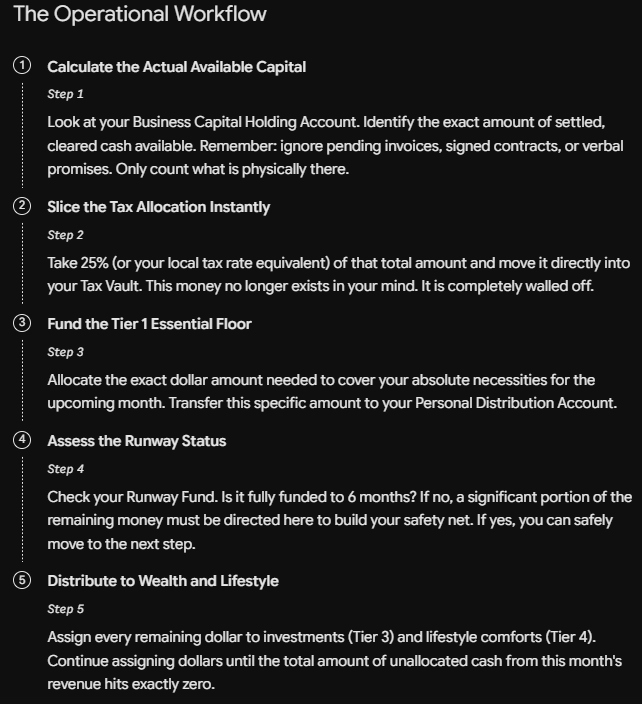
Mitigating the “Feast or Famine” Cycle
The real magic of adapting ZBB to freelancing lies in how you handle anomalous months. Let’s look at two specific scenarios to see how the system self-corrects dynamically.
Scenario A: The Famine Month (Low Income)
Imagine you have a terrible month where you only bring in $2,000 after taxes, but your baseline Tier 1 survival cost is $3,000. In a traditional percentage budget, you would panic.
Under the ZBB framework backed by a Runway Fund, the solution is mechanical. You allocate the entire $2,000 to Tier 1. You see a deficit of $1,000. You dynamically pull exactly $1,000 out of your Runway Fund to cover the gap. Tiers 3 and 4 receive exactly $0 this month. There is no guilt, no emotional breakdown—the system worked exactly as it was designed to, absorbing the macroeconomic shock.
Scenario B: The Feast Month (High Income)
Two months later, you land a massive project and clear $10,000. After setting aside $2,500 for taxes, you have $7,500 remaining. Your Tier 1 baseline is still $3,000.
Instead of upgrading your lifestyle and blowing the remaining $4,500 on luxury items, the ZBB system forces intentionality. First, you replace the $1,000 you borrowed from your Runway Fund during the famine month. Next, you aggressively route $2,500 into your long-term investment accounts. The final $1,000 is allocated to your Tier 4 lifestyle bucket, allowing you to celebrate your hard work responsibly without compromising your future safety.
Conclusion: Financial Peace of Mind is Structural
Freelance stress rarely stems from a lack of total income; it stems from a lack of clarity and control. When you don’t know where your money is going, every delayed invoice feels like an existential crisis.
By implementing a Zero-Based Budget customized for the volatile nature of independent work, you eliminate the guesswork. You strip away the emotional weight of financial management and replace it with a clinical, robust, and highly agile system. In the modern economy, flexibility is power—and giving every dollar a definitive job is the ultimate path to true financial independence.