

For the average consumer, a credit card is a tool of convenience or a short-term financing mechanism. They swipe, they pay their monthly bill, and perhaps at the end of the year, they redeem a nominal cashback reward that covers a few grocery trips. However, a growing global subculture of high-leverage financial strategists views the credit card industry through an entirely different lens. To them, the credit card ecosystem is a massive, highly inefficient arbitrage market. This practice is professionally known as Travel Hacking.
Travel hacking is not about cutting corners, exploiting illegal loopholes, or engaging in sketchy financial behavior. Rather, it is the systematic and highly legal optimization of credit card loyalty ecosystems, sign-up bonuses, and points-transfer topologies to unlock thousands of dollars in luxury travel for pennies on the dollar. In an era where international business class tickets routinely cost upwards of $5,000, travel hackers leverage daily operational expenditures to secure these exact same seats for near-zero out-of-pocket costs.
To successfully navigate this landscape as a professional, one must move past basic consumer habits and master the complex geometric mechanics of credit card rewards.
The Shift from Cashback to Transferable Currencies
The first fundamental error rookie consumers make is prioritizing direct cashback cards or fixed-value airline-specific cards. If your credit card gives you 1.5% cashback on all purchases, you are playing a losing game against inflation. Similarly, if you hold a co-branded airline card that forces you to redeem points exclusively within that single airline’s network, your capital is locked in a highly illiquid asset class prone to sudden devaluations.
Professional travel hacking relies entirely on Transferable Points Currencies. These are proprietary points issued directly by major banking ecosystems (such as Chase Ultimate Rewards, American Express Membership Rewards, or Citi ThankYou Rewards).
Transferable points are the premium currency of the financial world because they possess structural optionality. They do not belong to an airline or a hotel chain; instead, they sit in your banking vault until the exact moment you need them, at which point they can be routed dynamically to dozens of different airline and hotel partners. This flexibility allows you to exploit the arbitrage differences between how different airlines value the exact same flight route.
The Engine of Velocity: Sign-Up Bonuses (SUBs)
You cannot achieve luxury travel milestones quickly simply by spending $2.00 on coffee and earning 2 points at a time. To accumulate millions of miles, you must leverage the engine of Sign-Up Bonuses (SUBs).
Banks are locked in a perpetual, multi-billion-dollar war to acquire high-income, credit-worthy consumers. To win these customers, they offer massive upfront bonuses—often ranging from 60,000 to 150,000 points—if a user meets a specific minimum spending requirement within the first three to six months of opening the card (e.g., spending $4,000 in 90 days).
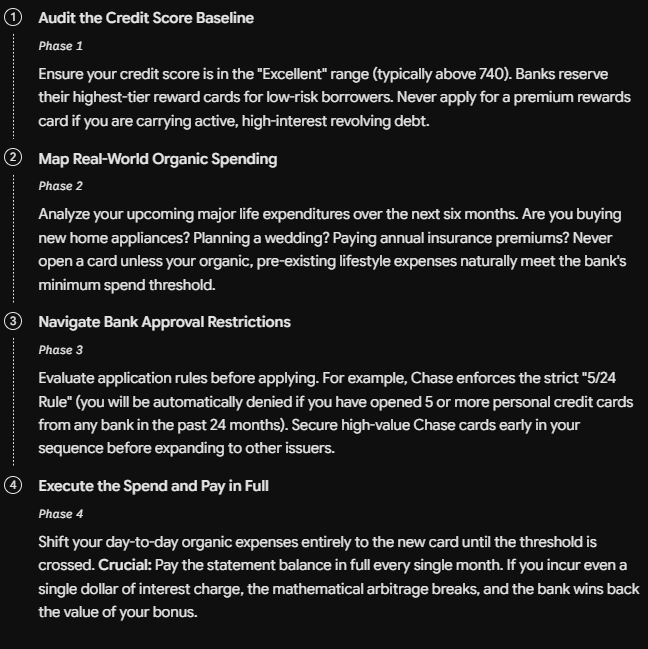
The Strategic Sequence for SUB Acquisition
To maximize these bonuses without falling into the trap of manufacturing artificial debt, professionals follow a highly disciplined timeline.
The Art of the Points Transfer Arbitrage
Once you have accumulated a massive war chest of transferable points, the real tactical game begins: Redemption Optimization.
Uneducated consumers often redeem their hard-earned points directly through the bank’s internal travel portal. For example, using 100,000 points inside a bank portal might yield a flat, fixed value of $1,000 or $1,250 toward a flight. This is a baseline redemption value of 1 to 1.25 cents per point.
Professionals almost never use bank portals. Instead, they transfer those 100,000 points out of the bank and directly into a partner airline’s frequent flyer program. Let’s look at a concrete real-world scenario to see how this multiplies the value of your money.
Portal vs. Transfer Arbitrage Case Study: Imagine a one-way business class ticket from New York to Tokyo costs $8,000 in cash.
- Inside the Bank Portal: At a fixed 1.25 cents per point, you would need a staggering 640,000 points to buy that ticket.
- Via Transfer Partner: By transferring those points to an airline alliance partner (like Virgin Atlantic or ANA), that exact same business class seat can frequently be booked for just 47,500 to 60,000 miles plus nominal airport taxes.
By utilizing the transfer partner framework, you have extracted roughly 13 to 16 cents of value per point. You achieved the exact same luxury travel experience while using less than 10% of the points the average consumer would have burned inside the bank’s closed loop. This is the core mathematical victory of travel hacking.
Managing the Ecosystem: Fees, Logistics, and Organization
Maintaining a premium multi-card strategy requires structural discipline. High-value rewards cards come with high annual fees, often ranging from $250 to $695 per card. To ensure these fees don’t drain your net worth, you must treat your card portfolio like a small business.
Every premium card offers built-in statement credits to offset its annual fee—such as annual airline detachment credits, hotel credits, digital entertainment subsidies, or lounge access passes. If a card costs $500 a year but naturally gives you $550 worth of credits for services you already pay for out-of-pocket, the card has a negative net cost.
However, if you forget to track these credits or fail to utilize them before they expire, the card becomes an expensive liability. Professionals use dedicated spreadsheet matrices or specialized financial tracking applications to monitor statement closing dates, annual fee posting deadlines, and credit utilization caps across their entire portfolio.
Conclusion: Reclaiming the System
Travel hacking is ultimately an intentional game of financial literacy. The credit card industry makes billions of dollars every year off the backs of consumers who pay exorbitant interest fees, carry massive revolving debt, or let their points sit unused until they expire.
By flipping the script—maintaining absolute credit discipline, paying balances in full, targeting hyper-valuable sign-up bonuses, and mastering the mechanics of transferable points conversions—you shift from being the product of the banking system to becoming its primary beneficiary. You reclaim your cash flow and convert your standard daily expenses into a master key that unlocks the finest travel experiences the world has to offer.