

For over a decade, the Financial Independence, Retire Early (FIRE) movement operated on a beautiful, almost utopian mathematical promise. The formula, derived from the landmark 1998 Trinity Study, was elegantly simple: scrape together enough capital to equal 25 times your annual living expenses—commonly referred to as your “FIRE Number”—and invest it entirely in low-cost index funds. Once that milestone was achieved, you could safely withdraw 4% annually, adjusted for inflation, and spend the remaining four to five decades of your life entirely free from the mandate of corporate labor.
During the prolonged bull market of the 2010s, this dream felt entirely within reach for high-earning tech professionals and aggressive minimalists alike. It spawned a massive subculture of extreme frugality, where people proudly maxed out their retirement accounts while living on beans, rice, and roommates in high-cost cities.
However, as we navigate the macroeconomic realities of 2026, the traditional foundational pillars of the FIRE movement are facing an existential crisis. The global economy has fundamentally shifted. Structural inflation, soaring real estate costs, volatile equity markets, and skyrocketing healthcare expenses have exposed massive vulnerabilities in the classic static retirement formulas.
To survive this new economic paradigm, the FIRE movement has had to evolve. The era of rigid, extreme deprivation followed by total early leisure is dying. In its place, a more resilient, highly adaptable framework has emerged: Dynamic Financial Independence.
The Structural Collapse of the Traditional 4% Rule
To understand why the old FIRE model is struggling under modern conditions, one must analyze the mathematical assumptions of the 4% Safe Withdrawal Rate (SWR). The Trinity Study calculated this rate based on historical market performance throughout the 20th century, a period characterized by specific economic cycles that do not neatly mirror the structural complexities of today.
The primary enemy of early retirement in 2026 is Sequence of Returns Risk (SRR) combined with compounding inflation. If an individual retires at age 32 with $1.5 million, and the stock market experiences a prolonged downturn or flat growth during the first three to five years of their retirement, the math breaks down.
When you are forced to actively liquidate depreciating assets to fund your baseline living expenses during a market correction, you permanently cannibalize the principal capital. When you compound this with core inflation that continuously erodes the purchasing power of each dollar withdrawn, the historical safety net of the 4% rule rapidly degrades.
Furthermore, the original FIRE blueprints drastically underestimated long-term structural expenses. A 30-year-old planning a 50-year retirement horizon cannot accurately predict the trajectory of healthcare inflation or localized housing monopolies. What felt like a comfortable $40,000 annual lifestyle budget in 2016 requires significantly more capital today just to maintain identical living standards. Relying on a static, prehistoric percentage box is no longer a viable path to long-term safety.
The Evolution of FIRE: Breaking Down the Modern Sub-Genres
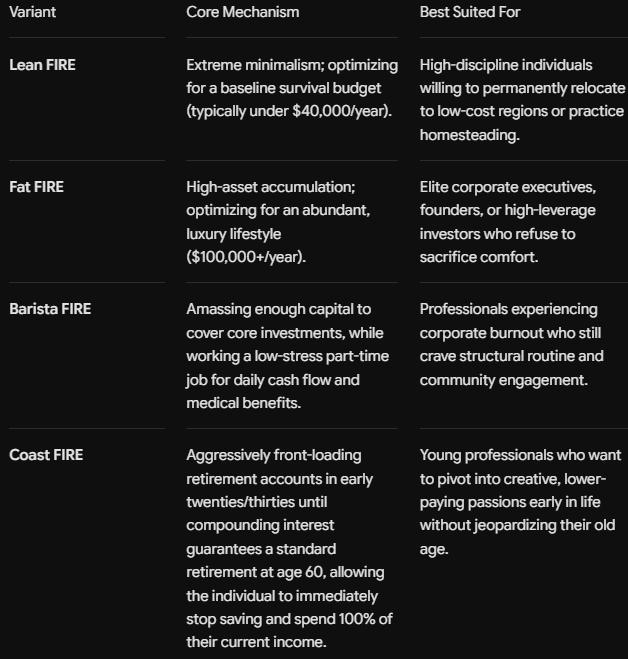
In response to these systemic shifts, the modern financial planning landscape has witnessed the fracturing of FIRE into distinct, highly specialized operational strategies. The community has largely abandoned the “one-size-fits-all” approach, recognizing that different psychological profiles and geographic realities require unique asset allocation structures.
The Tactical Framework for Resilient Modern FIRE
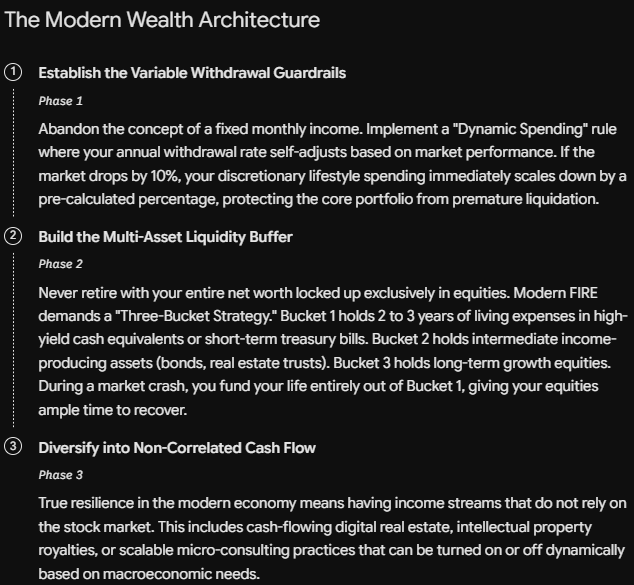
Achieving sustainable financial independence in the modern era requires a massive shift from passive indexing to active, defensive wealth architecture. If you are building a financial independence roadmap today, your system must incorporate three non-negotiable structural mechanisms.
The Psychological Pivot: From “Retire Early” to “Work Option”
Perhaps the most profound transformation within the FIRE community is not mathematical, but psychological. The original emphasis of the movement was heavily weighted toward the second half of the acronym: Retiring Early. The primary goal was to completely escape the workforce, delete LinkedIn, and spend decades traveling or resting.
However, behavioral studies and real-world testimonies from early retirees have revealed a glaring truth: total leisure without purpose frequently leads to identity crises, depression, and social isolation. Human beings are hardwired to seek mastery, autonomy, and purpose.
Consequently, the modern interpretation of FIRE has profoundly pivoted. The goal is no longer to achieve a state of permanent unemployment. Instead, it is about buying absolute sovereignty over your time. It is about reaching a point where work is entirely optional, allowing you to reject toxic corporate cultures, negotiate from a position of absolute power, and spend your intellectual energy exclusively on projects that carry deep personal meaning, regardless of their financial return.
Conclusion: The Ultimate Asset is Agility
The macroeconomic volatility of 2026 has stripped away the illusion that personal finance can be automated via a single spreadsheet rule. The old formulas are dead, but the underlying philosophy of the FIRE movement remains more relevant than ever.
Financial independence is not a static destination you arrive at by hitting a magical number; it is a continuous practice of structural agility, calculated risk management, and psychological design. By abandoning rigid percentage boxes, embracing dynamic withdrawal strategies, and focusing on time sovereignty rather than complete labor retirement, you construct a financial fortress capable of weathering any economic storm the future brings.